Mobile Optometrist vs Clinic Optometrist: Which Is Right for You?
TL;DR
Both a mobile optometrist and a traditional clinic optometrist deliver the same Medicare-funded comprehensive eye examination. The clinical content is identical and the bulk-billing rules are identical. What differs is where the appointment happens, the equipment posture (portable vs wall-mounted), the dispensing model and the practical fit with your life. Mobile is the right answer when transport, mobility, cognition, or scheduling makes a clinic visit hard. Clinic is the right answer when you already pass a high-street optometrist twice a week and have no access barriers. This article gives you a side-by-side comparison so you can decide.
On this page
Clinical content
Both models perform a comprehensive eye examination under Medicare item numbers 10900–10918. That examination includes history, visual acuity, refraction, binocular vision, intraocular pressure, anterior segment examination, optic nerve and macular assessment, and the issuing of a prescription where indicated. Neither model legally drops any of these steps.
The only clinical content difference in practice is the *dilated* fundus examination. In a clinic, an optometrist may dilate the pupils with tropicamide to get a wider view of the peripheral retina. Mobile optometrists usually rely on a wide-field handheld fundus camera instead, which gives a comparable peripheral view without the four-hour blur and light sensitivity that follows dilation. For most patients this is a net positive; for a small number of patients with suspected peripheral retinal pathology, a one-off in-clinic dilated examination may still be recommended.
Equipment posture
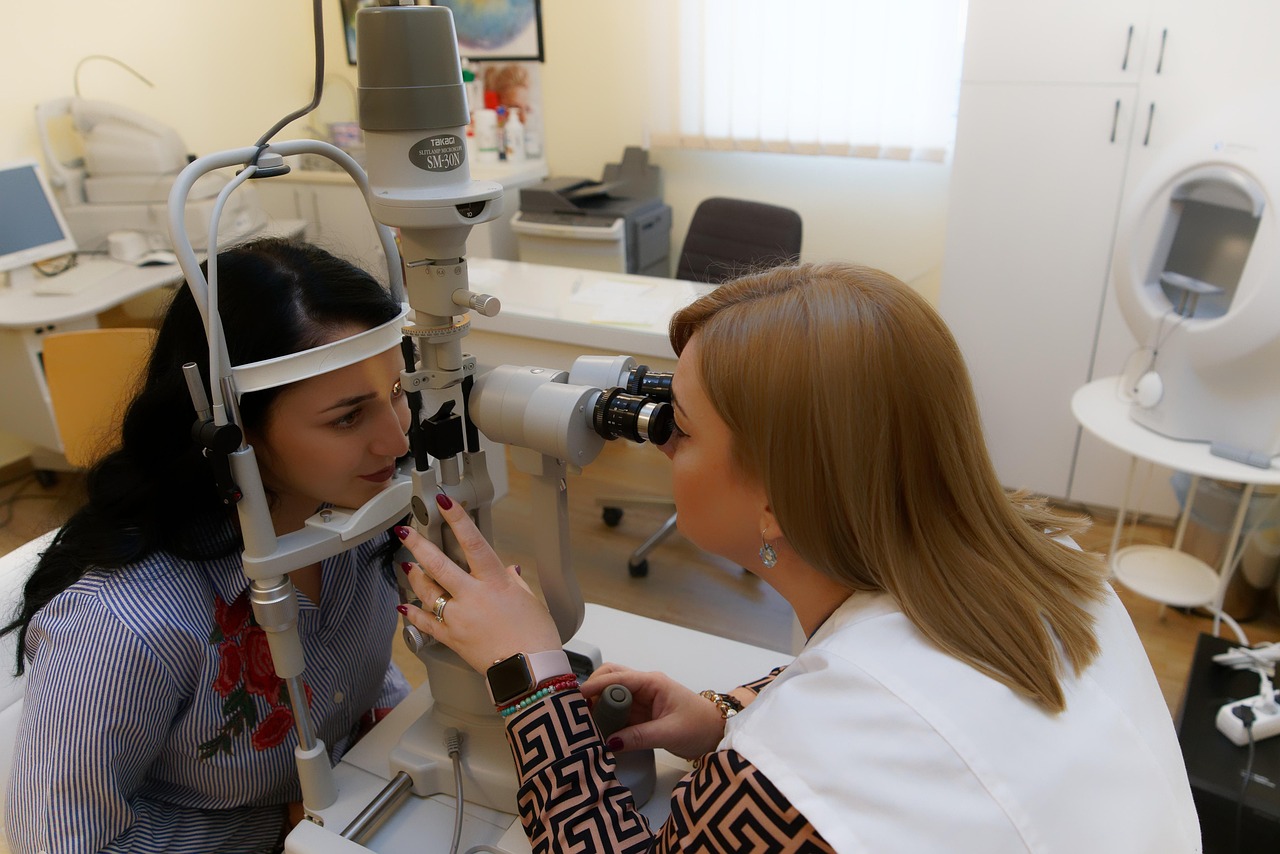
Clinic equipment is wall-mounted (phoropter, chinrest slit-lamp, table-mounted fundus camera, fixed Snellen chart). Mobile equipment is handheld and portable: autorefractor, portable slit-lamp, handheld tonometer, handheld retinal camera, trial-frame and trial-lens set, and a logMAR or Snellen card at a known viewing distance.
For a healthy, mobile adult sitting comfortably at a chinrest, wall-mounted equipment is marginally faster. For a frail elderly patient, a wheelchair user, a bed-bound resident, or a patient with dementia who cannot tolerate being pinned into a chinrest, the handheld kit is *clinically better* because the optometrist can come to the patient instead of forcing the patient into an awkward posture.
For a deeper look at why portable equipment is the right tool for aged care, read our on-site optometry in aged care article.
Cost and Medicare
In Australia, both models are bulk-billed for the comprehensive examination for Medicare-eligible patients. There is no out-of-pocket difference. Some mobile providers add a callout or service fee for individual residential visits outside their normal coverage area; reputable providers, including Eye See You, do not.
Glasses are the same price either way — they come from the same wholesale lens labs and the same major frame distributors. For an explicit cost breakdown see How much does a mobile optometrist cost? (And what Medicare covers).
Dispensing and glasses
A clinic dispenses from a large wall of frames (typically 200–600 SKUs). A mobile optometrist dispenses from a portable curated frame range (typically 40–100 SKUs) selected for the demographic being served — aged care frames, simple in-home frames, workplace safety frames.
For the patient choosing a fashion frame for a primary pair of everyday glasses, a clinic has more visual choice. For the aged care resident who needs a comfortable, lightweight, easily-replaced single-vision reading frame, the mobile range is more focused and typically more appropriate.
Glasses turnaround is 2–3 weeks either way, and both models will fit the glasses to your face at delivery rather than just handing them over.
Convenience and time cost
This is where the gap is largest. A clinic appointment for an aged-care resident typically requires:
Total: typically four to six hours of disruption per resident, often with the resident agitated by the unfamiliar environment.
A mobile visit is typically 30–45 minutes of contact time, in the resident's own room. No transport, no waiting room, no disruption. For a 60-bed facility, this changes from "vision care for the few residents whose families can take a half-day off work" to "vision care for every resident, every year." See our coverage in Brisbane, Sydney and Newcastle for what this looks like at scale.
Which model fits which patient
Mobile is clearly the right choice for:
Clinic is the right choice for:
For most aged-care, in-home and workplace situations, a mobile optometrist is not just *equivalent* to a clinic optometrist — it is the only model that actually gets the examination done.
Frequently asked questions
Is a mobile examination as thorough as a clinic examination?
Yes. The Medicare item numbers and the clinical scope are identical. The only meaningful clinical difference is that mobile typically uses wide-field retinal photography instead of pharmacological dilation; for most patients this is equivalent or better.
Can a mobile optometrist prescribe glasses just like a clinic?
Yes. The prescription is a regulated clinical document and is identical regardless of where the examination was performed. You can take the prescription anywhere.
Will my health fund cover a mobile visit?
Health fund rebates apply to the same items as a clinic visit — typically the glasses, not the examination (which is bulk-billed through Medicare). Your existing optical extras cover applies.
Should aged care residents have a mobile or clinic optometrist?
For residential aged care, mobile is the standard of care because the access barriers to clinic visits are so substantial that residents otherwise miss out. See Why mobile optometry is best for aged care.
How this guide connects to the rest of our content
Mobile optometry sits at the intersection of clinical eye care, aged care governance, and community health. The article above answers the immediate question, but most readers also need the wider picture — what the service looks like in practice, what it costs, where it runs, and how it interacts with the rest of the eye-care system. This short reference section makes those connections explicit so you can follow the trail that matters to your situation.
For families and individuals
If you are arranging eye care for an older parent or for yourself, the most useful next read is our pillar overview on what a mobile optometrist does, where we travel, and what Medicare covers. It walks through the appointment flow, glasses turnaround, and bedside delivery in a single page. From there, Booking your first mobile optometrist visit takes you through preparation step by step. If the recipient lives in a residential aged care home, the companion pillar — our aged care optometrist page — covers how facility-wide visits are scheduled and run.
For facility managers and clinical care coordinators
Facility teams usually need three things in one place: a procurement checklist, a clinical pathway, and accreditation evidence. The aged care optometrist visit checklist covers operational logistics — consent, medication interactions, room set-up, glasses inventory, and reporting. Our service hub on aged care optometry outlines clinical scope, reporting templates, reviewer credentials, and how the visit maps to the Aged Care Quality Standards. For an accreditation-cycle view, see our playbook on eye health for the aged care accreditation cycle, which is written for clinical governance audiences.
For GPs, ophthalmology rooms and community health teams
When the question is "optometry or ophthalmology?", our referrals decision guide outlines clinical scope, urgency criteria, and the shared-care pathways we use for residential aged care patients. It also covers what we report back after each visit, how we flag conditions that need urgent ophthalmology review, and how we coordinate when surgical follow-up is needed.
Where we travel
Eye See You Optometry runs scheduled mobile rounds across Queensland and New South Wales, including Brisbane, Gold Coast, Sunshine Coast, Sydney and Newcastle, plus the regional centres in between. If your suburb is not listed, call us — most postcodes are covered by an existing route or can be added with two to three weeks of notice.
*Eye See You Optometry runs mobile optometry across Queensland and New South Wales for aged care, in-home, post-operative and workplace patients. Book a visit or call 0490 090 713.*